Pocket Notebooks vs. A5 Journals: Which Size Fits Your Writing Life?
A practical comparison of pocket notebooks and A5 journals on portability, writing space, and daily use, with a hybrid setup that keeps both working.
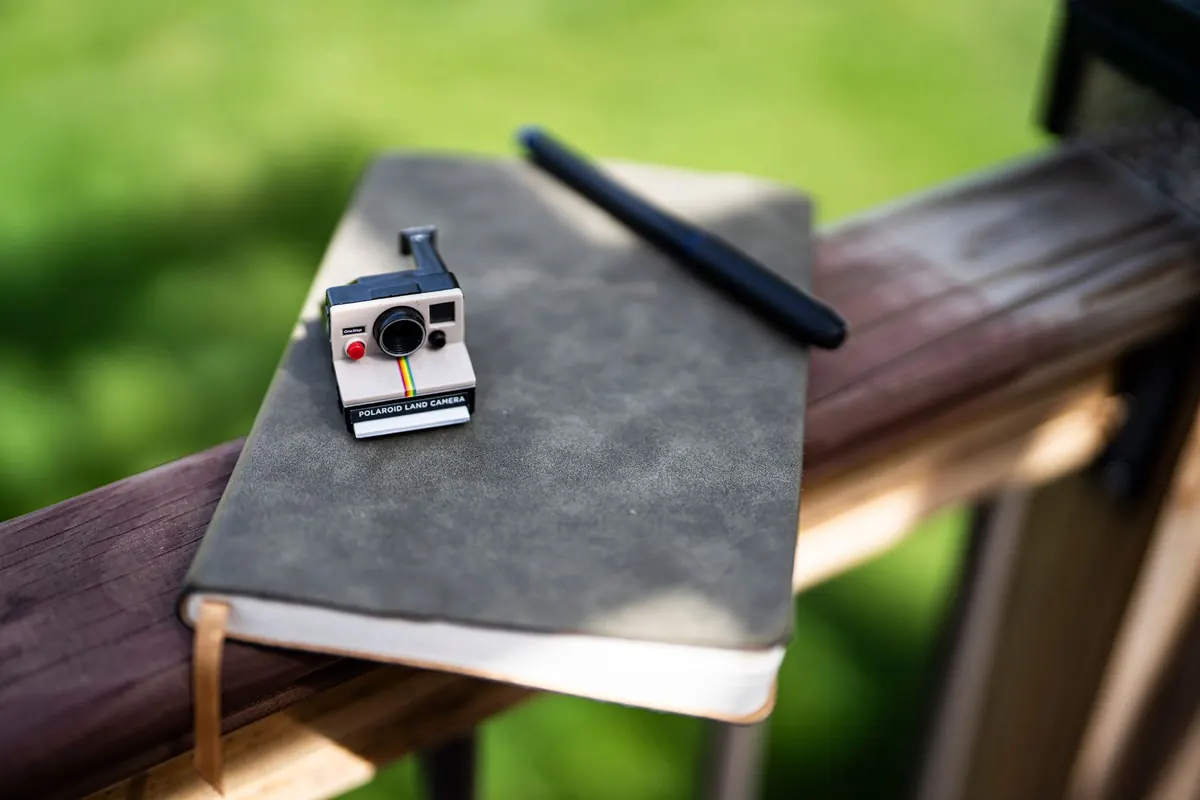
Most notebook decisions get made in a shop aisle, with a pocket-sized book in one hand and an A5 in the other, trying to picture a life you would actually live. The pocket one seems sensible. The A5 seems serious. You buy whichever feels better in that moment, and three weeks later it turns out to live in a bag you never carry.
Size is the least glamorous thing about a notebook and the thing that decides whether it gets used. What follows is a comparison on the parts that matter: what fits in your pocket, how much room your handwriting actually needs, and which format still makes sense on a wet Wednesday when you have four minutes and a head full of loose ends.
Portability: The Test That Settles Most Arguments
Pocket notebooks run roughly 9 by 14 cm, or about 3.5 by 5.5 inches. That is small enough for a jacket pocket, a shirt pocket at a push, and, if the cover is soft, a back jeans pocket, where it will pick up a curve and a permanent crease within a week. At 40 to 80 grams you stop noticing it is there. That is the whole point.
A5 measures 148 by 210 mm, which is a different category of object. It fits a tote, a messenger bag, a rucksack, a glovebox. It does not fit a trouser pocket unless the trousers are unusually ambitious. You carry it deliberately rather than by default, and the gap between deliberate and default is where most notebooks quietly die.
Here is the honest test. Think about the last three times you wanted to write something down and had nothing to write on. If those moments happened in a queue, walking to a station, or sitting on a step waiting for someone, a pocket notebook would have been there and an A5 would have been at home. If they happened at a desk with a coffee within reach, the A5 was already closer than you think.
Writing Space: How Much Room One Thought Needs
The usable page area in a pocket notebook is about 7 by 12 cm once margins are gone. With standard 5 mm ruling that gives you 15 to 20 lines. A lined A5 offers closer to 25 to 32 lines, and the lines are longer, so a sentence costs fewer of them.
This matters less than people expect, but it matters in a specific way: it comes down to the size of your handwriting. If you write large, a pocket line holds four or five words and a paragraph turns into a page-turn. If you write small and tight, one pocket page can hold a shopping list, a phone number, a task dump and a rough idea, separated by a horizontal line.
Where A5 wins without argument is reflection. An entry that runs 300 to 500 words, whether that is morning pages, a decision you are working through, or a record of something that happened, needs room to ramble. Compressing that into a pocket notebook means either writing microscript or spilling across six pages, and neither feels good enough to repeat.
You can measure this in two minutes. Copy the same real paragraph, not a test sentence, into both formats and watch where your pen slows down. If your hand starts crowding the edge of the pocket page, you have your answer for anything longer than a note.
A Side-by-Side Comparison
- Portability. Pocket wins decisively. It travels without a bag and without a decision.
- Page count. Pocket notebooks usually hold 48 to 80 pages; A5 journals commonly run 160 to 250. A pocket book lasts a few weeks of steady use, an A5 lasts months.
- Entry length. One to five lines and short lists suit the pocket format. Longer entries, dated reflections, project thinking and anything with a beginning, middle and end suit A5.
- Structure. A5 journals more often come with numbered pages, an index, a ribbon marker, an elastic closure and a back pocket. Pocket notebooks tend to be plainer, which is sometimes a relief and sometimes a nuisance.
- Durability. Pocket books take real abuse: corners curl, covers scuff, spines soften. A hardcover A5 survives a bag; a softcover one will bend if you let it.
- Cost per book. A pocket notebook usually costs less per book, which makes it easier to start a fresh one without ceremony and easier to abandon one that is not working. An A5 costs more up front, and that tends to make people timid about the first page.
- Best for. Pocket: capture, lists, ideas in transit, a record of the day in five lines. A5: journaling, review, planning, anything you want to read again later.
- Weak spot. Pocket: fills with fragments nobody revisits. A5: stays too pristine to be honest.
Read that list and one thing becomes clear. These two are not really competing for the same job. They are competing for the same pocket, bag and ten minutes of your evening.
Daily Use: Which One Survives an Ordinary Week
The pocket notebook problem
A pocket notebook is excellent at capture and terrible at review. It fills up fast, which feels productive, but a book with forty pages of half-sentences and no dates is not a journal, it is a shredder with better binding. Give it a date on every page and a single mark, a dot or a box, for anything you need to act on. Five minutes at the end of the week sorting those marks is the difference between a useful record and a pile of paper.
The A5 problem
An A5 journal fails for the opposite reason. It is big enough to feel like a commitment, so the first page gets postponed until you have something worth saying. Nothing is worth saying on a Tuesday, so the book stays blank for six weeks. The fix is unglamorous: write badly on purpose for the first week, keep it in one fixed place, and stop treating the page as a performance.
A5 also asks for a desk. If your writing happens on trains, in queues and on the edges of other people's conversations, the format will lose to your own schedule regardless of good intentions. If your writing happens after dinner with the plates pushed aside, it will thrive.
The pocket book is where things land. The A5 is where they get sorted out.
The Hybrid Setup Most People Settle On
If you cannot choose, you do not have to. Most longtime journal keepers end up running both, with a clear division of labour. It looks like this:
- Carry a pocket notebook as an inbox. Every phone number, idea, task and scrap of conversation goes there, dated at the top of each page.
- Keep one A5 journal in a single fixed place, whether that is the kitchen table, a desk drawer or the bag you take to work every day.
- Set aside ten minutes once a week to read the pocket book and move anything that still matters into the A5, in your own words rather than as a straight copy.
- Index both books at the back as you go, one line per filled page. Two minutes of indexing saves an hour of flipping.
- Retire the pocket notebook when it is full, write the date range on the cover, and keep it. A shelf of small books is a surprisingly good index of your own life.
Paper choice matters here too. If you use a fountain pen, a felt tip or a heavy gel roller, check for bleed-through before committing to a cheap pocket book, since thin paper is the most common disappointment in the small format. Any notebook in the 80 to 100 gsm range will handle most pens without ghosting badly.
How to Choose This Week
Answer three questions and the format usually picks itself. Where does most of your writing happen: on the move or at a table? How long is a typical entry: a few lines or a few paragraphs? Do you want a book you can read back in a year, or one that exists to get something out of your head right now?
Then act. Buy one pocket notebook and use it for two weeks without buying anything else. Note how often it fills up and what you actually wrote. If the pages are crowded with things you meant to keep, move up to A5 with a dot grid and the same pen. If your A5 has sat unopened for a month, downsize instead of giving up; a smaller page is a lower entry fee.
Buy the one you will carry, keep a pen clipped to it, and start on a date that is not January. The format that fits is the format you reach for without thinking, and you only find out which one that is by writing in both long enough to be annoyed by one of them.
Photo: Jason Morrison / Pexels